A Travel Journal of Sol & Moss
Chapter Two
The Stray Arrow
Thursday night
Everyone agreed that the arrow had caused the blackout.
By midnight, it was the fact Sol trusted least.
The arrow was still embedded in the electrical cabinet when he and Moss came back downstairs. Red-and-black feathers protruded from the dented gray metal at a slight upward angle. Someone had placed a folding chair in front of it, apparently on the theory that a chair constituted a barrier.
Rain struck the high windows of the range.
Nobody was shooting anymore.
Six targets stood at the far end beneath the emergency lights, their concentric rings reduced to shades of gray. Bows lay abandoned on the benches. A paper cup had been knocked over beside lane 4 and was slowly leaking coffee onto the floor.
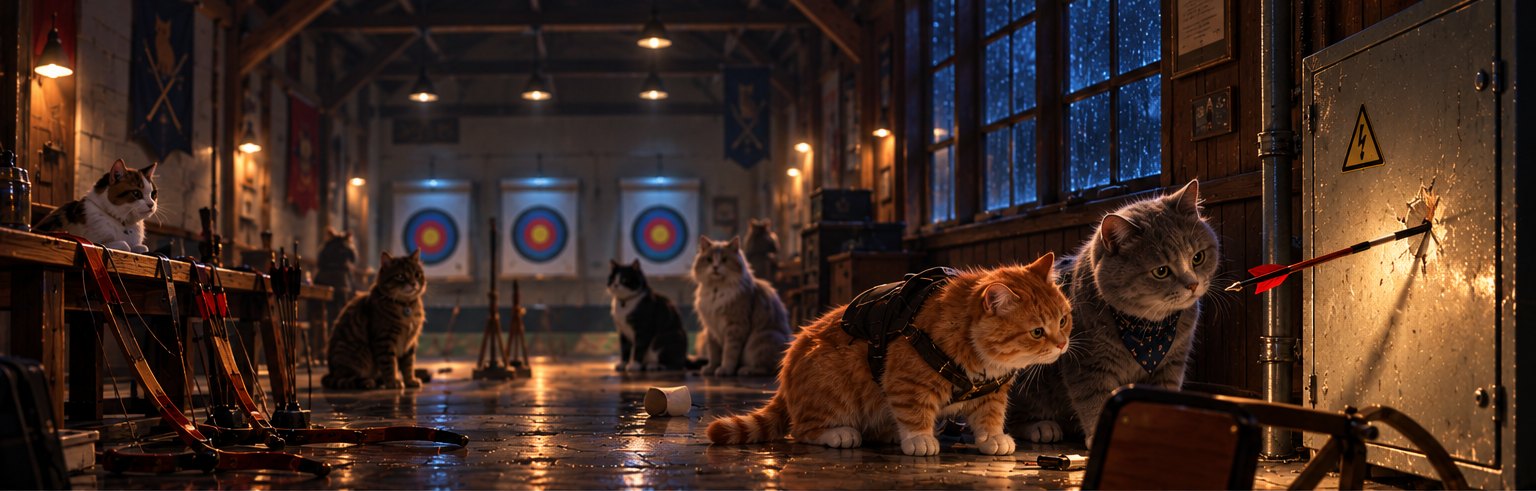
Moss stopped a few feet from the cabinet and leaned in.
“Don’t touch it,” Sol said.
“I wasn’t going to.”
“You were looking at it like you were going to.”
Moss straightened and folded his paws behind his back.
“Looking isn’t touching.”
“With you,” Sol said, “it’s usually the first step.”
Moss did not answer. It was, he had to admit, very nearly true.
Upstairs, the archive room had been sealed. The police photographer was still working inside. Down here, the remaining cats of the Bellweather Archery Club had arranged themselves into awkward little islands.
Nobody wanted to go home.
Nobody wanted to stand too close to anybody else.
The Bellweather Bow was gone.
For forty-eight years, according to the brass plaque in the archive, it had belonged to the club. Before that, it had belonged to Edwin Bellweather, who carried it when he won the North County Championship in 1939. It had been stored during the war, recovered after the flood of 1962, restored twice, insured three times, photographed endlessly, and—if the brochures were to be believed—had become less an object than a witness to the club’s history.
At 10:00 the next morning, Dr. Halden, a conservator from Boston, was supposed to authenticate it for the club’s centennial exhibition.
At 9:43 that evening, the lights had gone out.
There had been a metallic crack in the darkness.
When the emergency lighting came on, the arrow was in the cabinet.
Less than two minutes later, Merrin Vale went upstairs to check the archive.
The bow was gone.
The story had assembled itself almost instantly.
Someone had fired an arrow into the electrical system.
The lights had gone out.
In the darkness, someone had taken the bow.
Simple stories were dangerous that way.
They arrived already finished.
Moss crouched beside the cabinet without touching it.
Sol glanced toward him.
“What?”
“The arrowhead.”
“What about it?”
“Look.”
Sol crouched too.
The point had punched a shallow crater into the steel door. Paint had flaked away around the impact.
But there was no hole.
Sol leaned closer.
“No penetration.”
“No scorching either.”
Behind them, a voice said, “It hit the breaker.”
They turned.
Rowan Pike stood several yards away.
He was a lean black cat in a dark range jacket, arms folded tightly across his chest. He had been the last cat shooting before the blackout.
More importantly, the arrows in his quiver had red-and-black feathers.
Moss looked at the cabinet again.
“The breaker is inside.”
Rowan said nothing.
“So unless your arrows have learned to pass through steel,” Moss said, “this one didn’t hit it.”
Rowan’s ears shifted backward.
“It hit something.”
“Yes,” said Sol. “The door.”
That did not improve Rowan’s expression.
Across the range, Merrin Vale was speaking quietly to one of the officers.
She was the club’s treasurer, archivist, unofficial historian, and—judging by the number of cats who kept turning toward her—the cat everybody expected to know what to do when something went wrong.
She was older than most of the others, silver beginning to show around her muzzle. She had spent most of the evening wrapped in a green cardigan that seemed too ordinary for a crime scene.
Moss had met her twice before.
She remembered every cat’s name.
That sort of thing mattered in clubs.
Beside her stood Dr. Ivo Sable, who had arranged the authentication. He was staring at nothing.
Felix Rook stood alone by the trophy case.
Felix’s grandfather had been the last surviving relative of Edwin Bellweather’s doubles partner, and for the past six months Felix had been arguing publicly that the Bellweather Bow should never have belonged to the club at all.
He had used the phrase stolen inheritance at a committee meeting in August.
And Juniper Hall, the building manager, was sitting behind the front desk with both paws wrapped around a mug she had not drunk from.
The police would take formal statements.
Sol and Moss were not there to replace them.
Two days earlier, the club had asked them to look over the arrangements for the centennial opening. There had been questions about crowd flow, storage, the old electronic locks, and whether an eighty-year-old building should be trusted with a valuable artifact and several hundred visiting cats.
They had expected a dull evening.
By 1:00 a.m., that seemed optimistic.
The arrow belonged to Rowan.
That much did not take long.
He denied it first.
Then he denied it less confidently.
Then he said there were dozens like it.
There were not.
A thin white line circled the shaft just below the fletching.
Moss had seen the same hand-painted line on every arrow in Rowan’s quiver.
Rowan stared at it for a long time.
“I lost one last month.”
“Where?” Sol asked.
“Backstop.”
“Which lane?”
“Four.”
Moss looked toward lane 4.
“That’s where you were shooting tonight.”
Rowan’s jaw tightened.
“I shoot there often.”
Sol turned the arrow slightly using the evidence technician’s forceps.
There was fresh dust on the shaft.
No embedded foam.
No old adhesive.
Moss noticed Rowan watching the arrow rather than Sol.
That bothered him more than the denial.
“You know when this was fired,” Moss said.
Rowan looked at him.
It was not quite an accusation.
That was probably why it worked.
Rowan looked away.
“I want a lawyer.”
“That’s reasonable,” Sol said.
Moss glanced at him.
Sol returned the forceps to the technician.
“We can wait.”
Rowan looked almost surprised.
“You think I’m lying.”
“I think you’ve told us something that doesn’t fit the evidence,” Sol said. “That’s different from knowing why.”
Rowan’s ears remained flattened, but he said nothing more.
Moss followed Sol toward the door.
“You could have pressed him.”
“Yes.”
“Why didn’t you?”
“He’s frightened.”
“You noticed?”
“I have eyes, Moss.”
“That wasn’t what I meant.”
“I know.”
They continued upstairs.
At 2:14 a.m., Juniper Hall admitted that the service stair was not locked.
This was inconvenient because she had spent the previous hour insisting that it was.
The stair ran behind the old trophy room and connected the range level to the archive corridor. It was narrow, unheated, and officially closed while the building waited for a fire-door replacement.
Unofficially, cats still used it.
“Why lie?” Moss asked.
Juniper rubbed both eyes.
“Because if I say that door was being used, it becomes my fault.”
“Was it?”
“No.”
“Was what?”
“The theft.”
“That isn’t what I asked.”
Juniper gave him a tired look.
Moss waited.
“No,” she said finally. “It wasn’t supposed to be in use. Yes, cats used it.”
“Who?”
“Every cat who knew it was there.”
Sol was standing halfway up the stair.
“That’s almost everybody.”
“Exactly.”
He continued upward.
Moss followed.
The stair came out twelve feet from the archive room.
Unlike the glass display cabinet inside, which was secured mechanically with brass catches and a locking pin, the archive room itself had an electronic access lock.
During a power failure, the lock was supposed to transfer to a small backup battery.
Earlier that evening, in the confusion immediately after the lights failed, Juniper had said she was not sure whether the transfer had worked properly.
That uncertainty had spread quickly.
If the electronic lock had briefly released, then perhaps someone could have slipped inside.
Now Juniper looked embarrassed.
“The battery should have held it.”
“Should have?” Moss asked.
“It was tested in June.”
“So the door should remain locked during an outage.”
“Yes.”
“Does it release automatically?”
“No.”
Sol glanced at her.
“Even for a second?”
“Not if it’s working correctly.”
That did not completely eliminate the possibility of a failure.
But it made the blackout considerably less useful to a thief than everyone had first assumed.
Sol checked his watch.
“Again.”
They went downstairs.
Then upstairs.
Juniper watched them do this three times.
On the fourth, Moss said, “We look ridiculous.”
“We looked ridiculous the second time.”
“Then why are we doing it four times?”
“You were slower on the third.”
“I was opening the door.”
“The thief would also need to open the door.”
Moss considered this.
“Fine.”
They went down again.
From lane 4 to the archive door by the main staircase: fifty-eight seconds at a brisk walk.
By the service stair: thirty-four.
Running brought it under twenty-five.
“That would be enough to reach the archive,” Sol said.
“Empty-pawed.”
Sol looked at him.
Moss gestured toward the narrow turn at the top of the staircase.
“You’re measuring how quickly a cat can get there. Not how quickly a cat can leave carrying a bow.”
“We haven’t established that anyone left by this stair.”
“Then we should establish whether they could.”
Sol glanced at the turn.
Then at the floor plan in his paws.
“Find something five feet long.”
Juniper produced a spare target stand from the equipment room.
It was awkward, heavier at one end, and nearly impossible to turn sideways without striking the wall.
Sol carried it first.
He made the upper corner in one attempt, but the lower end caught against the handrail.
Moss looked at his watch.
“Forty-six seconds.”
“That includes getting stuck.”
“The thief would also need to avoid getting stuck.”
Sol gave him a look.
Moss smiled.
They tried again.
This time Moss carried the stand while Sol timed him.
He was slower.
“Fifty-three,” Sol announced.
“I didn’t hit the wall.”
“Congratulations.”
“You did.”
“I was testing the clearance.”
“Of course.”
The experiment proved little about the identity of the thief. But it established that the fastest route to the archive was not necessarily the fastest route out with the bow.
And that was before they added the cabinet.
The Bellweather Bow had not been hanging openly on the wall. It had rested in a padded conservation cradle inside a glass-fronted cabinet. The cabinet had two brass catches, a locking pin, and a fitted support around the grip.
Merrin demonstrated with the empty cradle.
Even knowing exactly what to do, she needed thirty-one seconds to open the cabinet and release the supports.
Forty-three to do it without letting the bow strike the glass.
Longer if the room was dark.
Then the thief had to conceal an object nearly five feet long.
And either remain upstairs or return downstairs.
“Unless they didn’t return,” Juniper said.
Sol looked at her.
“Who didn’t?”
She hesitated.
“Felix wasn’t on the range when the lights went out.”
That was the first time either of them had heard that.
Felix Rook had been in the locker room.
Possibly.
There was no cat who could confirm it.
He said he had gone there because he had a headache.
Sol asked why his coat was wet.
Felix looked down at it.
“I went outside.”
“When?”
“Before.”
“Before what?”
“The blackout.”
“How long before?”
“I don’t know.”
Moss had begun to dislike the word before.
It was doing too much work.
Felix’s quarrel with the club was real. He believed the Bellweather Bow had been given away under questionable circumstances after Edwin Bellweather’s death. He had hired an attorney. He had sent three letters. He had stood up at an August meeting and told Merrin, in front of twenty-seven members, that if the club would not return the bow voluntarily, he would find another way.
Merrin remembered the sentence exactly.
Felix remembered it differently.
“I said I’d find another legal way.”
“You left out legal at the meeting,” Merrin said.
“You were shouting.”
“I don’t shout.”
Felix laughed once.
Nobody else did.
There was an old hostility between them, the kind that had been rehearsed enough times to become almost comfortable.
That made it tempting.
Too tempting, perhaps.
Moss watched Merrin while Felix spoke.
She did not seem frightened of him.
She seemed tired of him.
There was a difference.
When Felix left, Sol wrote his name at the top of a fresh page.
“Convenient suspect,” he said.
“He has a motive.”
“He has an argument.”
“An argument can become a motive.”
“Yes. And a headache can become a convenient alibi.”
Moss looked toward the trophy case, where Felix had resumed his solitary watch.
“You don’t believe him?”
“I haven’t decided.”
“About the headache?”
“About which part of his story matters.”
Moss said nothing.
It was an irritating answer.
It was also a useful one.
At 3:00 a.m., Dr. Ivo Sable asked for his briefcase.
An officer retrieved it.
Inside were photographs of the Bellweather Bow, correspondence with the Boston conservator, and seventeen pages of notes.
Moss read them standing beside the vending machines.
The first page was mostly measurements.
The second discussed the grip.
On page 4, one sentence had been underlined twice.
Conservator’s notes, page 4Lamination appears inconsistent with documented 1930s repair techniques.
Moss read it again.
Then the paragraph beneath it.
The conservator had questions.
Not accusations.
Questions about the wood, the varnish, a repair beneath the lower limb, and a maker’s mark that appeared in a photograph taken six months earlier but not in some much older images.
Moss looked across the lobby.
Dr. Sable was watching him.
“You thought it was fake.”
“No.”
“You thought it might be.”
“I thought a cat who knows more than I do should examine it.”
“Did Merrin know?”
Dr. Sable’s expression changed very slightly.
“Yes.”
“Since when?”
“Tuesday.”
The bow disappeared Thursday night.
Sol had come over without Moss noticing.
“What happens if it’s fake?”
Dr. Sable looked toward the centennial banners hanging above the front desk.
“That depends on how long the club knew.”
Moss followed his gaze.
One banner read:
A hundred years. One unbroken tradition.
Dr. Sable said, “They’ve used the bow in fundraising materials. Insurance valuations. A grant application. The exhibition catalogue is already printed.”
“Would anybody go to prison?”
“I don’t know.”
“Would the club survive?”
Dr. Sable took a while to answer.
“I don’t know that either.”
For the first time that evening, the missing bow seemed less like the valuable thing.
Moss closed the folder.
Across the lobby, Merrin was helping Juniper sort the names of members who had already given statements.
She had taken Juniper’s untouched mug away and returned with fresh tea.
Sol followed Moss’s gaze.
“You like her.”
“She’s been good to the club.”
“That wasn’t what I said.”
“No.”
“Doesn’t make her innocent.”
“I know.”
Sol waited.
Moss looked down at the folder again.
“She remembers everyone’s name,” he said.
“That’s a lot of names.”
“Yes.”
Neither cat said anything for a moment.
Then Sol took the folder and opened it to page four.
At 3:27 a.m., Sol found Moss asleep sitting upright in a wooden chair.
He kicked the leg.
Moss opened one eye.
“If the building is on fire, tell me.”
“It isn’t.”
“Then this was unnecessary.”
“The power company called back.”
That woke him.
The outage had affected three buildings on the block.
Utility outage log9:43:11 p.m.
A transformer had tripped during the storm.
Automatic restoration began ninety-four seconds later.
Moss sat up.
“What about the electrical cabinet?”
“Nothing.”
“The arrow didn’t—”
“No.”
Moss stared toward the range.
For a few seconds neither cat said anything.
Then Moss stood.
They walked downstairs.
The folding chair was still in front of the electrical cabinet.
Sol moved it aside.
The arrow remained exactly where it had been.
Moss looked at the shallow dent.
Then at the emergency lights.
Then back at the arrow.
“The lights went out first.”
“Yes.”
“How sure?”
“Utility timestamp.”
“The witnesses?”
“Half say the impact came first. Half say they happened together.”
Moss looked at him.
“And Rowan?”
“Hasn’t changed his story.”
“He doesn’t have a story.”
“Exactly.”
Moss folded his arms.
“What happens to an archer who’s already at full draw when the room suddenly goes black?”
Sol looked downrange.
Neither of them needed to answer.
Rowan lasted twenty seconds.
“I didn’t mean to release it.”
His voice had changed completely.
There was no indignation left in it.
“I was at full draw. Everything went black. Somebody behind me shouted. I flinched.”
“You heard it hit the cabinet?” Moss asked.
Rowan nodded.
“Why not say so?”
“Because I fired an arrow into a dark range.”
Nobody said anything.
Rowan rubbed a paw over his face.
“I knew what that would sound like.”
“What?”
“Like I caused it.”
He looked toward the cabinet.
“When the lights came back and everyone started shouting about the power, I thought…”
He stopped.
“You thought if you kept quiet,” Sol said, “the evidence would explain itself.”
Rowan gave a small, miserable nod.
Moss looked at Sol.
Sol was looking at the arrow.
A lie could belong to the wrong question.
They had spent several hours asking whether Rowan had fired it.
They should have been asking when.
By 4:00 a.m., the story everyone had told at 9:45 p.m. was dead.
The arrow had not caused the blackout.
The blackout had caused the arrow.
Which meant the arrow had nothing to do with the theft.
Probably.
Sol wrote the word on the bottom of a page.
PROBABLY.
Then drew a box around it.
Moss read over his shoulder.
“You don’t trust coincidences.”
“I trust them perfectly.”
“You look offended.”
“I don’t trust explanations that need them too badly.”
That was different.
Moss sat opposite him.
The club office was quiet now. Rain pressed softly against the windows.
On the table lay the evening’s pieces: access printouts, photographs, the conservator’s letter, a floor plan, the program for the centennial, and a sheet of paper on which Moss had written the whereabouts of every cat in the building between 9:40 and 9:45.
None of it quite fit.
Felix could possibly have reached the archive.
Juniper knew the service stair.
Rowan had lied.
Dr. Sable had reason to fear what the authentication might reveal.
And Merrin—
Moss stopped.
“What?”
Sol had seen it.
“Nothing.”
“That wasn’t a nothing face.”
“I don’t have a nothing face.”
“You have several.”
Moss picked up one of the photographs.
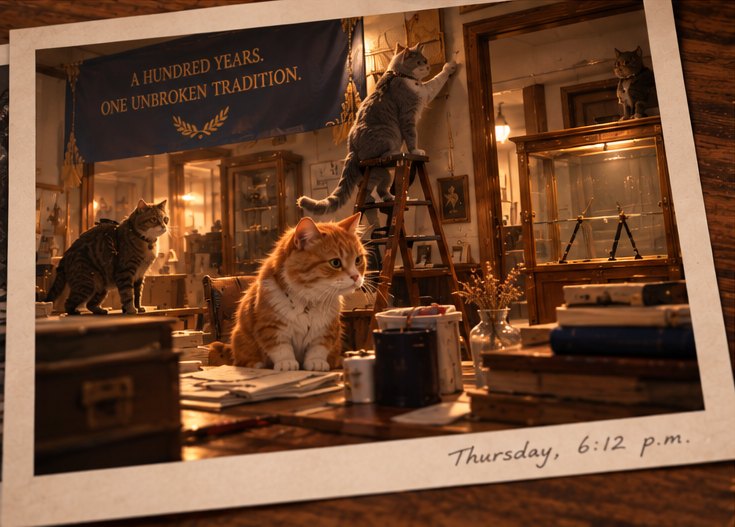
It had been taken that afternoon by the club’s volunteer photographer while they were arranging the centennial display.
Merrin was in the foreground holding a stack of labels.
Juniper stood on a ladder.
Felix was visible through the open doorway of the trophy room.
Moss had already looked at the photograph twice because it established which cats had arrived before 6:00.
Now he looked at the background.
The archive door was open.
Inside, beyond Merrin’s shoulder, stood the glass display cabinet.
There was glare across the front.
He tilted the photograph toward the lamp.
Sol came around the table.
“What time?”
Moss checked the metadata printed on the contact sheet.
“6:12 p.m.”
Sol leaned closer.
The cabinet was difficult to see.
But not impossible.
The padded cradle inside made a dark horizontal line.
Above it was empty glass.
Moss said nothing.
Sol took the photograph from him and held it closer.
“Where’s the bow?”
Neither of them moved.
At 6:12 p.m., the Bellweather Bow was already gone.
More than three hours before the blackout.
The strange thing was that this did not immediately tell them who had taken it.
It made nearly everybody less suspicious and one cat considerably more interesting.
Merrin had told the police that she had checked the bow shortly after 7:00.
Not casually.
Specifically.
Around 7:15, perhaps 7:20.
She remembered because Dr. Sable had asked whether the humidity monitor had been reset before the conservator arrived.
Moss found her statement.
There it was.
Statement of Merrin ValeI saw the Bellweather Bow in the cabinet shortly after 7:00 p.m.
Moss put the photograph beside it.
Sol said, “Could the photograph be misleading?”
“Yes.”
“Reflection?”
“Possible.”
“Angle?”
“Possible.”
“Could the bow be below the frame?”
“No.”
“How do you know?”
Moss pointed at the cradle.
The top retaining strap was hanging loose.
If the bow had been in place, the strap would have crossed the grip.
It was visible.
Empty.
Sol sat back.
“That’s better.”
“It isn’t enough.”
“No.”
They both knew that too.
A contradiction was not a crime.
Not yet.
At 5:15 a.m., Juniper remembered the banner case.
They had not asked about the bow.
They were asking what had been removed from the building that afternoon.
“Two folding tables. One broken target frame. The old centennial banners.”
“Who took the banners?” Moss asked.
“Merrin.”
Sol looked up.
Juniper continued.
“She said they were the wrong year. She put them in the long blue carrier.”
“How long?”
Juniper held her paws apart.
Then farther.
“Long.”
“Where is it?”
“Her car, I think.”
The police searched the car.
The blue carrier was not there.
Merrin said she had taken it to the storage shed behind the old field course.
That was true.
They found it there at 6:12 a.m.
Inside were four rolled vinyl banners.
And beneath them, wrapped in gray conservation cloth, was the Bellweather Bow.
Or what everyone had called the Bellweather Bow.
Merrin did not confess immediately.
Moss was glad of that.
Immediate confessions always made reality feel badly written.
She sat at the same table where she had spent the night helping them reconstruct the theft.
Sol placed the 6:12 p.m. photograph in front of her.
Then the photograph of the recovered bow.
Then Dr. Sable’s letter.
Merrin looked at all three.
Her face did not change much.
Outside, the storm had passed. The windows were turning slowly blue.
“I didn’t steal it during the blackout,” she said.
“No,” Moss said.
“You know that.”
“Yes.”
“And Rowan’s arrow had nothing to do with it.”
“No.”
She looked toward the range.
For a moment, she almost smiled.
“That arrow was extraordinary luck.”
Sol said nothing.
Merrin folded her paws.
“I had already taken the bow outside.”
“At 6:00?” Moss asked.
“Before 6:00.”
“Why?”
She looked at Dr. Sable’s letter.
“Because I knew what they might find tomorrow.”
Nobody spoke.
Merrin reached for the photograph but did not pick it up.
“My father brought me here when I was seven. I learned to shoot in lane 2. When the roof collapsed in the winter of ’91, half the members rebuilt it themselves. When we couldn’t pay the heating bill, some cat always found the money.”
Her voice remained level.
“This club is not important because of that bow.”
Sol said, “Then why hide it?”
Her eyes moved toward him.
“I didn’t know what else to do.”
For the first time that night, she looked tired rather than composed.
“I found the mark on Tuesday. I compared the old photographs. I called a curator I know at the county museum. He wouldn’t tell me anything definite from photographs alone, but he said enough.”
She looked down.
“By Wednesday, I knew there was a real possibility that the bow in that cabinet was not the Bellweather Bow.”
Moss said, “So cancel the authentication.”
“I thought about it.”
“Why didn’t you?”
“Because Dr. Halden was already coming from Boston. Because the board had announced the authentication months ago. Because the exhibition opens next week. Because canceling it the day before would make every cat ask exactly the question I wasn’t ready to answer.”
She paused.
“And because I thought I could fix it.”
Moss looked at her.
“How?”
“I don’t know.”
There was something almost angry in the answer.
Not at him.
At herself.
“I thought maybe there had been a substitution in storage. Maybe an old loan nobody recorded properly. Maybe the original was in another case. Maybe Bellweather’s estate had retained it and sent us a display copy. There are a hundred years of papers upstairs, half of them never catalogued properly.”
She touched the edge of the photograph.
“I wanted time.”
“To look for the real one.”
“To find out whether there even was a real one somewhere to find.”
Her voice softened.
“I thought if the bow disappeared for a few days, the authentication would have to be postponed. I could say there had been a problem with the display, or with security, or that it had been moved while we checked the provenance. I hadn’t decided.”
Moss watched her.
“You were going to make it disappear.”
“Temporarily.”
“And search on your own.”
“Yes.”
“You thought you could find an explanation before anyone else had to know.”
“Yes.”
It was not a good plan.
That was almost beside the point.
It was the sort of plan a frightened cat made at the moment when the thing she had spent half her life protecting began to come apart in front of her.
Sol leaned against the wall.
“But you hadn’t worked out what happened next.”
Merrin looked at him.
“No.”
“You had removed the bow.”
“Yes.”
“And?”
“I was going to think.”
Sol glanced at Moss.
Moss understood.
“After hiding the main piece of evidence.”
Merrin almost laughed.
“When you say it like that, it sounds very stupid.”
“It was very stupid,” Sol said.
Moss looked at him.
Sol added, “Also understandable.”
Merrin looked away.
Then, very quietly:
“The lights went out.”
Moss could see it.
Not as something planned.
As a moment.
A dark building.
A shout.
A metallic crack.
A room full of startled cats reaching for phones and flashlights.
Somebody saying the arrow must have hit the electrical system.
Juniper, trying to remember the building schematics, saying she wasn’t sure whether the archive’s electronic door lock might have released when the power failed.
And Merrin, who had spent the previous two days desperately wishing for time, suddenly seeing time appear.
“What did you do?” Moss asked.
“I said we should check the archive.”
“The door?”
“It was still locked.”
“Because of the backup battery.”
“Yes.”
“So you used your access card.”
“Yes.”
The access log confirmed that much.
Archive access log9:45 p.m. · Merrin Vale · Authorized entry
“You went in,” Moss said.
“Yes.”
“And then you announced that the bow was gone.”
“Yes.”
“You let everyone assume it had disappeared during the outage.”
Merrin looked at him.
“I didn’t invent that assumption.”
“No.”
Moss glanced toward the range.
“But you didn’t correct it.”
“No.”
The room stayed quiet.
Merrin folded her paws more tightly.
“At first I thought it might buy me a few hours. Then everyone started talking about theft. The arrow. Felix. The stairwell.”
“And you kept letting the story grow.”
“Yes.”
“Why?”
She took a long time to answer.
“Because every minute it grew, I became more afraid of stopping it.”
That, Moss thought, was probably the first completely honest answer she had given all night.
The bow had disappeared before 6:00.
But from the moment Merrin returned from the archive and said, It’s gone, every cat in the building had begun solving a theft that supposedly occurred around 9:43.
They argued about stairs.
Distances.
Electronic locks.
Keys.
Who was standing where.
Who could run how fast.
Who owned the arrow.
Who hated whom.
The hardest part of Merrin’s deception had not been hiding the bow.
It had been allowing everyone else to decide when it had disappeared.
And the arrow had done most of that work for her.
Not because it was evidence.
Because it was a story.
There was still one question left.
It belonged to Dr. Sable.
“If this is a replica,” he said, looking at the recovered bow, “where is the original?”
Nobody answered.
Merrin shook her head.
“I don’t know.”
For a few seconds Moss thought that might be where the story ended.
He disliked it.
The question had been sitting in front of them all night.
He returned to the photographs.
There were dozens.
The Bellweather Bow at the club’s fiftieth anniversary.
The Bellweather Bow after the 1962 flood.
The Bellweather Bow in the old clubhouse.
The Bellweather Bow in Edwin Bellweather’s paws.
Sol came over.
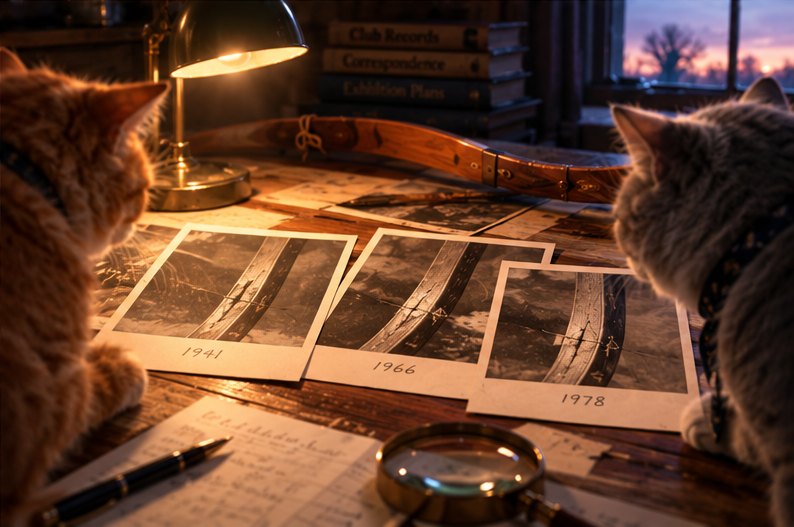
Moss placed two photographs side by side.
One was dated 1941.
The other was the club’s accession photograph from 1978, taken when Bellweather’s estate formally transferred a bow to the club.
“Look at the lower limb.”
Sol looked.
The 1941 bow had a narrow diagonal repair about six inches above the grip.
A pale splice in the wood.
Moss added another photograph.
1966.
The repair was there.
Then 1972.
Still there.
Then 1978.
No repair.
Sol moved the photographs closer together.
For once, he did not say anything immediately.
Finally:
“Then the bow in the 1978 photograph isn’t the same bow as the one in these.”
Dr. Sable leaned over the table.
He checked the dates.
Then checked them again.
“If the records are correct,” he said slowly, “then that would mean the club never received the original Bellweather Bow.”
Nobody spoke.
That was not quite the same thing as proving what had happened.
The photographs could be mislabeled.
An undocumented restoration might have altered more than anyone realized.
The estate records might be incomplete.
There were still too many missing pieces.
But one thing had changed.
The question was no longer merely what had happened Thursday night.
Whatever had happened to the original bow—if these records meant what they appeared to mean—might have happened before the club ever believed it owned it.
Nearly half a century earlier.
Merrin stared at the photographs.
Then she gave a small laugh.
There was no humor in it.
“So I did all of this,” she said, “because I was terrified the club had been lying for forty-eight years.”
Moss looked at the photograph from 1978.
“Maybe it wasn’t.”
She looked up.
“Maybe the club was wrong for forty-eight years.”
Merrin said nothing.
That distinction seemed very small.
It wasn’t.
They left shortly after sunrise.
The rain had washed the street clean. Water gathered in the gutters and reflected the pale morning sky.
For once, Sol did not put on his sunglasses.
Moss noticed but decided not to say anything.
They walked half a block before Sol spoke.
“You were wrong about Felix.”
“You were wrong about the service stair.”
“I abandoned that.”
“After making us run it four times.”
“Three and a half.”
“Four.”
“The first was reconnaissance.”
Moss looked at him.
Sol’s expression remained perfectly serious.
“That is not how counting works.”
They walked another few steps.
Behind them, the old archery hall stood with its lights on again.
Moss glanced back.
“The arrow was closer to the truth than any of us.”
Sol looked at him.
“It was completely unrelated to the truth.”
“Exactly.”
Sol considered this.
“That sentence makes no sense.”
“It will when I write it down.”
“You’re going to write this down?”
Moss put his paws into his coat pockets.
“Eventually.”
A delivery truck rolled through a puddle at the intersection.
Sol stepped around the water.
Moss stepped through it.
After another block, Sol said, “You know what bothered me?”
“The questionable bow?”
“No.”
“The insurance?”
“No.”
“Merrin letting everyone suspect Rowan?”
“Closer.”
Moss waited.
Sol looked back once at the shrinking archery hall.
“Everyone wanted the arrow to matter.”
Moss thought about that.
The dent in the cabinet.
The missing bow.
Felix’s threat.
Rowan’s lie.
The service stair.
The electronic lock.
The conservator’s letter.
The photograph at 6:12 p.m.
All of them had mattered.
Just not in the ways they first appeared to.
“Maybe because it was dramatic,” Moss said.
“Probably.”
“And close to everything else.”
“Close isn’t the same as connected.”
“No.”
They reached the next intersection.
The shortest route home continued straight ahead. Moss knew it well. Three blocks, a narrow passage behind the bakery, and then the little bridge over the canal.
Sol turned left.
Moss followed.
Neither mentioned it.
For a while, they walked without speaking.
Moss thought about the photographs spanning decades.
About a club remembering an object more faithfully than any cat had ever examined it.
About Merrin hiding a questionable bow beneath four rolled banners because she thought a few extra days might somehow be enough to save everything.
About Rowan standing in the dark with a bow drawn, startled into releasing an arrow that would become, for several hours, the center of a crime it had nothing to do with.
And about a tiny pale repair visible in old photographs, waiting quietly for some cat to notice that one day it had disappeared.
“The truth,” Moss said at last, “might have been sitting there for forty-eight years.”
Sol nodded.
That answer seemed to satisfy him.
They kept walking.
Not because it was the shortest way home.
It wasn’t.
To be continued
Written by Lianrui Zuo · revised by ChatGPT (grammar and language) and Claude (formatting)