A Travel Journal of Sol & Moss
Chapter One
A Cat Between Two Worlds
Saturday, 9:47 p.m.
It was a quiet Saturday evening.
Outside, the rain had stopped, leaving tiny droplets clinging to the leaves in Moss’s garden. A few late-autumn flowers stood beneath the porch light, their petals bowed under the weight of the water. The house smelled faintly of tea, old books, and the cinnamon candle Moss had lit after dinner.
Moss sat at his desk by the window.
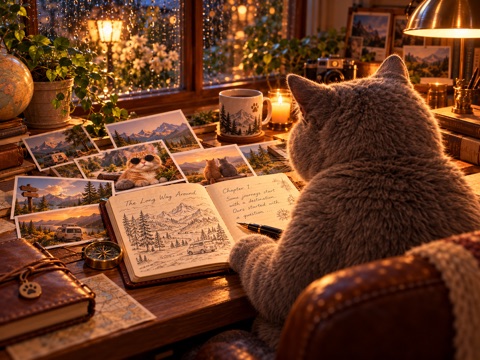
He had intended to do something productive.
There was a list, naturally. Moss was very fond of lists. There were emails to answer, plans to organize, and a particularly troublesome expense report that had been waiting for his attention since Tuesday.
He opened his laptop.
Then he closed it.
He opened it again.
After several minutes of staring at the same unfinished sentence, he decided that perhaps a cup of tea would help.
The tea did not help.
What troubled him was not the work itself. His mind was somewhere else.
Sol was away on a long journey, somewhere beyond the mountains. His last message had arrived that afternoon.
Arrived. Weather terrible. Food acceptable.
Moss had promptly sent several questions about the weather, the roads, and whether Sol had remembered to bring his coat.
Sol had replied:
Yes, Mom.
A moment later, another message arrived.
Roads are fine. Coat is warm. Stop worrying.
Moss had spent an unreasonable amount of time deciding whether the first reply was funny.
He eventually decided that it was.
Now the house felt unusually still.
Sol was not a noisy cat. Quite the opposite. He could sit in the same room for hours without saying a word, apparently satisfied with the company of his own thoughts.
Yet his absence had a strange way of making the silence louder.
Moss glanced toward the kitchen.
One mug stood in the drying rack.
For some reason, that bothered him more than it should have.
He turned back to his desk.
Beneath a stack of unopened mail lay a small, worn notebook. Its brown cover had softened with age, and several loose photographs stuck out between the pages.
Moss pulled it free.
He had bought the notebook years ago, intending to keep a careful record of his travels: dates, destinations, expenses, interesting places to visit again.
It had not worked out quite as planned.
The first few pages were reasonably organized. Then came sketches, pressed leaves, restaurant receipts, hurried observations, and occasional complaints about Sol’s navigation skills.
Near the middle, Moss found an old photograph.
Three cats sat side by side.
On the left was Sol, a young orange tabby wearing a pair of perfectly round black sunglasses.
On the right was Moss himself, looking rather round, rather serious, and considerably less comfortable in front of the camera.
Between them sat a most peculiar creature.
Half orange.
Half gray.
One half wearing sunglasses.
The other staring directly into the camera with a bright golden eye.
Moss laughed.
He remembered that day.
He remembered it as clearly as if it had happened yesterday.
And with that, the unfinished expense report was forgotten.
It had begun with an argument about sunglasses.
Not an important argument, although Sol would later insist that it concerned a matter of fundamental personal freedom.
They had been walking through a little seaside town on an unusually warm afternoon. The streets were filled with tourists, colorful shopfronts, and the smell of fresh bread drifting from a bakery.
Sol walked with his usual unhurried confidence, wearing his sunglasses even though they had spent most of the morning beneath heavy clouds.
Moss had been watching him for several minutes.
“Can I ask you something?”
“You just did.”
“Something else.”
“Go ahead.”
“Why do you always wear those sunglasses?”
Sol considered the question.
“Because I look cool.”
“Yes, but surely there are times when you don’t need them.”
“Name one.”
“Indoors.”
“Still cool.”
“When it’s raining.”
“Especially cool.”
“At night?”
“Different kind of cool.”
Moss sighed.
He had learned that conversations with Sol often ended where they began, except that Sol appeared considerably more satisfied with the result.
They continued down the street until Moss spotted a small photography studio tucked between a souvenir shop and the bakery.
In the window hung a handwritten sign:
Two portraits for the price of one!
Memories that last forever.
Moss stopped.
“That looks nice.”
Sol followed his gaze.
“It’s a photography studio.”
“I know.”
“We have cameras.”
“I know that too.”
“Then why pay someone else to take a photograph?”
Moss studied the sample portraits in the window. Families, friends, newlyweds, and one remarkably dignified-looking rabbit sat against warm, softly lit backgrounds.
“Because it might be fun.”
Sol regarded the window for a moment.
“Fun costs extra?”
“Sometimes.”
“A disturbing economic principle.”
Moss smiled and reached for the door.
Sol glanced once at the sample portraits, then at Moss, who was already looking considerably happier.
He followed him inside.
The photographer was an elderly tortoiseshell cat with enormous spectacles and a cheerful disposition.
She directed them toward a cream-colored backdrop, adjusted a large studio lamp, and asked them to sit close together.
Moss sat.
Sol sat at the opposite end of the bench.
“A little closer, please,” she said.
Moss shuffled toward the middle.
Sol remained where he was.
“Closer,” the photographer repeated.
Moss shuffled again.
Sol looked at him.
“You know,” Sol said, “there’s a perfectly good amount of space over there.”
“The photographer wants us closer.”
“Why?”
“Because we’re taking a picture together.”
“We’re both in the picture.”
“Sol.”
“What?”
“Just move.”
Sol moved approximately two inches.
It was, in his opinion, a generous compromise.
Then, noticing that Moss was still sitting rather awkwardly at the edge of the bench, Sol shifted another inch without being asked.
Neither of them mentioned it.
The photographer adjusted her spectacles.
“Excellent. Now, one of you is orange and the other is gray. What a lovely contrast!”
Moss smiled.
Sol nodded, as if he had personally arranged the color scheme.
“Would you like to remove your sunglasses for the portrait?” she asked.
“No.”
“Perhaps just for one photograph?”
“No.”
“Your eyes might look lovely in the light.”
“They do.”
Moss covered his face with one paw.
The photographer, who had worked with difficult customers for forty years, wisely decided to proceed.
There was a flash.
Then another.
The photographer disappeared behind a curtain to prepare the prints.
A few minutes later, they heard a surprised exclamation.
“Oh, dear.”
Moss sat up.
“Is something wrong?”
The photographer emerged carrying a photograph.
“Well,” she said, “I’ve made a little mistake.”
She held it out.
In the picture, Sol and Moss sat at opposite ends of the bench, exactly as they had arranged themselves.
But between them was a third cat.
A perfectly blended combination of the two.
Half orange, half gray.
Half sunglasses, half bare face.
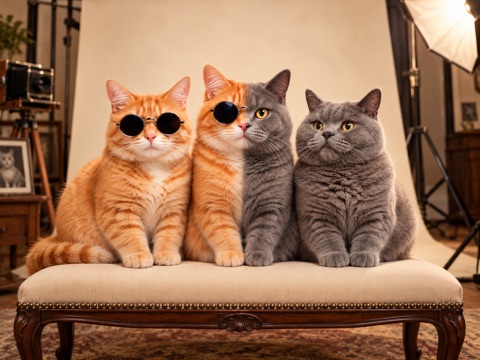
The photographer stared at it in bewilderment.
“My equipment has been behaving rather strangely lately.”
Sol leaned forward.
For several seconds, he said nothing.
Then he nodded appreciatively.
“Handsome fellow.”
Moss burst out laughing.
It was not a polite chuckle. It was the sort of helpless laughter that made his shoulders shake and his eyes water.
Sol looked at the photograph again.
“He has my good side.”
“Which side is that?” Moss managed.
“The orange one.”
Moss laughed harder.
The photographer offered to retake the picture free of charge.
Moss immediately agreed.
Sol, however, held up the first print.
“We’re keeping this.”
“Really?” asked the photographer.
“Of course.”
“Why?”
Sol studied the strange little cat between them.
“Limited edition.”
They left the studio with two proper portraits, one defective photograph, and considerably less dignity than they had arrived with.
The afternoon had turned golden. Sunlight stretched across the cobblestones, and a mild breeze carried the smell of the sea.
Moss was still smiling as they walked.
“I can’t believe you wanted to keep that picture.”
“It’s a good picture.”
“It’s ridiculous.”
“Those aren’t mutually exclusive.”
Moss glanced at Sol.
“Don’t you think it’s strange?” Moss asked.
“What?”
“That little cat. Half you, half me.”
Sol considered the photograph.
“Poor thing.”
“Sol!”
“One half has excellent judgment. The other half worries about the weather.”
“Someone has to worry about the weather,” Moss protested.
“That’s what forecasts are for.”
They passed a café with a small terrace overlooking the harbor.
Moss slowed down.
There were empty tables beneath striped umbrellas. A chalkboard outside advertised afternoon tea and lemon cake.
Sol continued walking for several steps before noticing that Moss was no longer beside him.
He turned.
“What?”
“Nothing,” said Moss. “I was just looking.”
“At cake.”
“At the view.”
“The cake is in the view.”
Moss hesitated.
“We could stop for a little while.”
“We just had lunch.”
“That was two hours ago.”
“An eternity.”
Moss smiled, uncertain whether Sol was agreeing or refusing.
Sol looked at the terrace, then at the road ahead.
“Fine,” he said. “But we’re sitting in the shade.”
“Why?”
“Too much sunlight.”
Moss looked at the enormous black sunglasses on Sol’s face.
He wisely said nothing.
They took a table overlooking the harbor.
Sol chose the seat facing the street, leaving Moss the better view of the boats.
Moss ordered tea and a slice of lemon cake. Sol ordered coffee and announced that he did not want dessert.
When the cake arrived, Sol ate approximately half of it.
Moss found this unsurprising.
For a while, they sat watching little boats moving in and out of the harbor. A gull landed on a nearby railing, examined them with professional interest, and departed when it became clear that no crumbs would be forthcoming.
Moss took out the strange photograph again.
He placed it between their cups.
“You know, I think I like this one better than the proper picture.”
Sol looked at it.
“Better composition.”
“No, not that.”
“What, then?”
Moss thought for a moment.
He had spent much of his life trying to understand where things belonged. Flowers in the right part of the garden. Books on the proper shelves. People in their comfortable places.
He liked things to fit.
The little cat in the photograph did not fit anywhere in particular.
It was orange and gray. Familiar and unfamiliar. Rather absurd, yet somehow perfectly content to sit between them.
“I suppose,” Moss said slowly, “he doesn’t have to choose which one of us to be.”
Sol looked at the photograph.
“Good for him.”
Moss smiled.
“I mean it.”
“I know,” said Sol.
For a moment, neither cat spoke.
Then Sol pushed the remaining piece of cake toward Moss.
“You should finish that before the gull comes back.”
Moss looked at the cake.
Then at Sol.
“Thank you.”
“Don’t mention it.”
For the rest of the afternoon, they made no particular effort to accomplish anything.
They watched the boats, discussed the questionable navigation of a fishing vessel, and disagreed about whether the clouds suggested rain.
Moss believed they did.
Sol believed Moss worried too much.
It rained twenty minutes later.
Sol pretended not to notice.
Back at his desk, years later, Moss turned the photograph over.
On the back, written in his own careful handwriting, were the words:
Seaside. Saturday afternoon. The day the camera invented a third cat.
Below that, in another handwriting, someone had added:
Better-looking than either original.
Moss smiled.
He had forgotten that Sol had written that.
Outside, the wind stirred the branches of the little tree beyond his window.
The clock showed 11:16 p.m.
His laptop had gone to sleep.
The expense report remained unfinished.
Moss reached for his pen.
On the first clean page of a new notebook, he wrote:
The Long Way Around.
He paused, then added:
Some things are worth remembering properly.
He thought about the little seaside town, the peculiar photographer, the rain that caught them without umbrellas, and the way Sol had quietly handed him the last piece of cake.
There had been so many afternoons like that.
Some had been extraordinary.
Some had been ridiculous.
Some, at the time, had seemed hardly worth mentioning.
Moss wondered how many he could still remember.
His phone buzzed.
A message from Sol.
Made it to the hotel. They gave me a room with a view.
A photograph followed.
It showed a window overlooking a dark mountain valley. Beyond the glass, a few distant lights shone beneath a cloudy sky.
In the bottom corner of the photograph sat a paper cup of tea.
A second message arrived.
Terrible tea.
Moss smiled and began typing.
You should get some rest. It's getting late. Don't forget—
He stopped.
Deleted the sentence.
Then wrote:
The view is beautiful. Wish I could see it with you.
He stared at the words for a moment before sending them.
There was no response.
Moss placed the phone beside his notebook.
He looked again at the strange little cat in the photograph and laughed softly to himself.
A minute later, the phone lit up.
Next time.
Moss read the message twice.
Then he put the photograph carefully between the pages of his new notebook.
Outside, the night had grown quiet again.
He opened his laptop one last time.
The expense report could wait until Sunday.
Tonight, he had a story to tell.
To be continued
Written by Lianrui Zuo · revised by ChatGPT (grammar and language) and Claude (formatting)